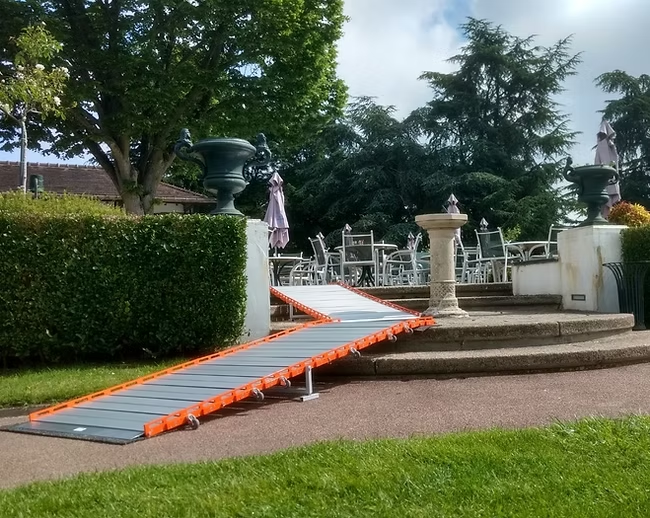
Wheelchair Ramp — the right ramp for your situation
A wheelchair ramp bridges the height difference at your front door, back entrance or commercial building. MIOR supplies aluminium wheelchair ramps built for daily use — no drilling, no permanent fixtures.
What is a wheelchair ramp?
A wheelchair ramp is an inclined surface that bridges the height difference between two levels — at a front door with steps, a back door to the garden, or the entrance to a shop or care facility. The goal: independent and safe access with a wheelchair, mobility scooter or rollator.
Not every wheelchair ramp is the same. The right choice depends on the height difference, how often it will be used, the type of wheelchair, and the space available. A 10 cm threshold calls for a different solution than a 40 cm flight of steps — and a solution for a rented home differs from one for a care facility with daily professional use.
MIOR wheelchair ramps are made from 6082-T6 aluminium — the same structural grade used in aerospace and marine engineering. Every ramp supports 400 kg, is weather-resistant and comes with a 2-year manufacturer warranty. Designed and manufactured in the Netherlands.
When do you need a wheelchair ramp?
Front door with steps or a high threshold
The most common scenario. One or more steps at the front door block wheelchair or scooter access. A roll-up wheelchair ramp (MIOR ROLL) solves this without permanent installation.
Back door or garden access
The step to your garden, terrace or balcony is too high for a wheelchair or rollator. A ramp provides safe access and can be rolled up and stored when not in use.
Care home or nursing facility
Daily intensive use by multiple residents with powered wheelchairs and mobility scooters. MIOR ramps are engineered for this workload — 400 kg rated, anti-slip, weather-resistant.
Shop, restaurant or office
Temporary or semi-permanent wheelchair access at a commercial entrance. No drilling, quick to lay out and easy to remove after use.
Van or care vehicle
A permanently mounted wheelchair ramp for daily boarding and disembarking. The MIOR DRIVE model is purpose-built for this — gas-spring deployment, one-hand operation.
Events, stages and temporary access
A modular ramp solution for stages, exhibitions or temporary venues. MIOR ROLL combined with Platform sections and turn-sections creates a custom route regardless of height.
Which wheelchair ramp suits your situation?
MIOR offers three product lines — each designed for a specific type of use.
MIOR ROLL
Roll-up aluminium wheelchair ramp. Modular in length, ready to use instantly without installation. For homes, shops, care facilities and events.
From €549
View MIOR ROLL
MIOR FOLD
Folding aluminium wheelchair ramp. Compact enough for the car, strong enough for daily use.
From €499
View MIOR FOLD
MIOR DRIVE
Vehicle-mounted wheelchair ramp with gas-spring deployment. Permanently fitted in your van, operable with one hand.
From €1,299
View MIOR DRIVERamp length and slope: how to calculate
The most important factor in choosing a wheelchair ramp is the required length — which is determined by two things: the height difference you need to bridge, and the slope you need to achieve.
A commonly used planning reference is the 1:12 ratio: for every centimetre of height, 12 centimetres of horizontal distance. Whether that slope suits you depends on the user, the mobility aid and any assistance. Because the ramp also rests on the top step, the product is longer than the horizontal distance — for a 30 cm height difference, the calculator gives a 4.0 m MIOR ROLL at 1:12.
The table below comes from the MIOR calculator's own rules for the MIOR ROLL: the compact length (1:5) and the 1:12 reference, including the 30 cm that rests on the step, in 20 cm steps. Use the calculator for your exact height and the space you have.
Indicative lengths for the MIOR ROLL
MIOR ROLL, FOLD and DRIVE — side by side
| Model | Type | Price |
|---|---|---|
| MIOR ROLL | Roll-up | From €549 |
| MIOR FOLD | Folding | From €499 |
| MIOR DRIVE | Vehicle-mounted | From €1,299 |
Portable vs permanent: which is right for you?
Portable wheelchair ramps — like the MIOR ROLL and FOLD — require no installation, no drilling and no structural changes to the building. This makes them ideal for rented homes, listed buildings, shared entrances and temporary situations. You place the ramp, use it, and roll it away.
Permanent or vehicle-mounted ramps — like the MIOR DRIVE — are built into the structure or vehicle and offer the most seamless daily experience. They are typically chosen for professional care transport or high-frequency commercial use where convenience outweighs the installation cost.
For most home and care situations, a portable roll-up or folding ramp is the faster, more flexible and more cost-effective solution. No planning permission, no contractor, no waiting period — you can be set up in minutes.
Wheelchair ramp cost: what affects the price?
The price of a wheelchair ramp depends primarily on the ramp length: a longer ramp requires more material and typically weighs more. MIOR ramps start from €499 (FOLD) and €549 (ROLL), with the price increasing incrementally per 20 cm of additional length.
The MIOR DRIVE vehicle model starts from €1,299 and includes professional installation — the significantly higher price reflects the mounting system, gas-spring mechanism and vehicle-specific engineering.
Use the MIOR calculator for a direct price estimate based on your height difference. All prices exclude VAT. MIOR supplies detailed quotes for funding applications — check with your local municipality whether accessibility ramps qualify for local support schemes.
Which ramp width do you need?
Indoor and outdoor use
MIOR wheelchair ramps are designed for both indoor and outdoor use. The 6082-T6 aluminium frame is corrosion-resistant and unaffected by rain, frost or prolonged sun exposure. The anti-slip profile on the surface provides traction in wet conditions.
For outdoor use, ensure the ramp is placed on a firm, level surface. On uneven paving, gravel or grass, the stability of the ramp depends on the ground conditions — the MIOR ROLL adapts to slight surface variations because of its flexible profile. For permanently uneven surfaces, contact MIOR for advice on the appropriate configuration.
Practical ramp examples
How to choose the right wheelchair ramp
Measure the height difference
Measure the total height of your threshold or steps in centimetres. This is the single most important number — all ramp length advice starts here.
Consider your use case
Fixed location at home or a care facility? Choose ROLL. Need to take it in the car? Choose FOLD. Permanently in a vehicle? Choose DRIVE.
Check available floor space
Make sure you have enough space in front of the steps for the ramp to rest at a safe angle. If space is limited, a shorter ramp creates a steeper slope — use the calculator to find the right balance.
Measure free with WEXAR
Point your smartphone at the threshold. WEXAR calculates the exact height, ramp length and gives a tailored product recommendation — free, no appointment needed.
Frequently asked questions about wheelchair ramps
How much does a wheelchair ramp cost?
Can a wheelchair ramp be installed without drilling?
Is a wheelchair ramp suitable for a powered wheelchair?
What is the delivery time for a MIOR wheelchair ramp?
Can a wheelchair ramp stay outside all year round?
What length wheelchair ramp do I need?
What is the difference between MIOR ROLL and MIOR FOLD?
Can I get a wheelchair ramp for a van or care vehicle?
How do I choose the right ramp width?
Does MIOR provide documentation for funding applications?
Need help choosing your wheelchair ramp?
Measure your situation free with WEXAR or get in touch for personal advice. We'll guide you to the right wheelchair ramp — no obligation.