Wheelchair Ramp for Two Steps — Length, Slope and Right Solution
Two steps at a front door or entrance are more common than you might expect — and more of a barrier than they look. For a wheelchair user or someone pushing a mobility scooter up an entry porch, two steps without a ramp means no independent access. The right ramp changes that — without construction, without drilling, and without long waiting times. But the two steps must be measured together, and the combined height determines the required ramp length. Measure both steps as one total height difference — then choose the right length.
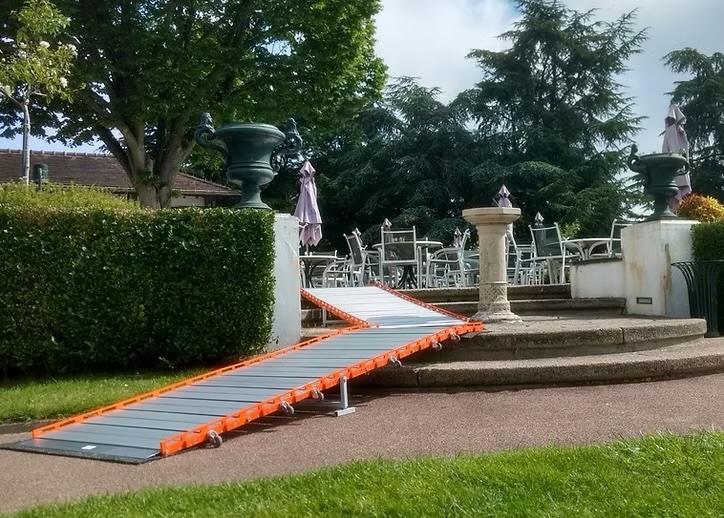
MIOR ROLL for two steps. MIOR indication: 1.8 m (approx. 6 ft). Always measure your specific situation.
The situation
You have two steps at a front porch, side entry or raised entrance — typically 30–36 cm (12–14 in) combined height. You need a portable ramp that can be set up and removed without tools, ideally used as a daily solution without permanent fixtures. This could be a temporary need — post-surgery recovery, a visiting family member — or a long-term solution where flexibility matters more than permanence.
Why measuring matters
At 30 cm of combined height, the 1:12 reference guideline gives a ramp length of 3.6 m (approx. 12 ft) — longer than many people anticipate, and longer than many front garden spaces allow. The MIOR practical indication for two steps is 1.8 m for assisted manual wheelchair use. This is a steeper slope than the 1:12 reference, but manageable in a supported daily care context. For powered wheelchairs, heavier scooters or independent self-propelling users, a longer ramp is advisable. Available floor space in front of the steps is equally important — measure this before deciding on a ramp length.
Practical MIOR Indication
Typical step height
30–36 cm (approx. 12–14 in)
Practical MIOR indication
1.8 m (approx. 6 ft)
Use case
manual wheelchair with assistance — two-step entry
1:12 comparison (ADA reference)
3.60–4.32 m
These examples are intended as practical MIOR indications. The correct ramp length depends on the exact height, available space, user, mobility aid and intended use. For more comfortable or guideline-aligned use, a longer ramp may be needed.
How to measure correctly
Step 1: Measure the total combined height of both steps — from the floor at the bottom to the top surface of the upper step. Not per step individually. Step 2: Measure available floor space in front of the steps. Do you have at least 150–180 cm? Then a 1.8 m ramp fits. Step 3: Consider your mobility aid — what is the total weight of the user plus the device? This affects which slope is manageable. Step 4: Use the MIOR calculator with your exact combined step height for a direct length recommendation, or use WEXAR for a free digital measurement via smartphone.
Measure with WEXAR
WEXAR measures your combined step height and available floor space via smartphone — free, no account needed, no appointment required. Particularly useful for two-step situations where the interplay between height and available space determines what length is feasible. The WEXAR measurement result can also be used as supporting documentation for local funding applications. WEXAR helps you capture height, available space and slope on your smartphone. The result is intended as a digital indication and preparation tool. For formal ADA assessments, insurance reimbursement decisions or permanent structural modifications, review by a qualified professional or occupational therapist is recommended.
📱 Learn more about WEXAR →MIOR ROLL — the solution
The MIOR ROLL is available in multiple lengths and is well suited to two-step access. The 6082-T6 aluminium profile is weather-resistant and anti-slip — suitable for outdoor two-step entry use year-round. No tools or installation: roll it out, use it, roll it back up. For two steps with limited floor space in front, contact MIOR for advice on whether a platform combination or alternative configuration would better suit your situation.

Aluminium anti-slip profile. Lightweight and roll-up for easy storage.
Frequently asked questions
How long a ramp do I need for two steps?
The required length depends on the combined height of both steps, your available floor space and the mobility aid being used. For a combined height of 30–36 cm, the MIOR practical indication is 1.8 m for assisted use. The 1:12 reference guideline gives 3.6–4.3 m. Use the MIOR calculator with your exact height for a direct recommendation.
Can I place a portable ramp on two steps without installation?
Yes. The MIOR ROLL requires no drilling, screws or installation. Lay it flat from the upper step to the floor, and roll it up after use. One person can do this comfortably.
Is 1.8 m long enough for two steps?
The 1.8 m is a practical MIOR indication for assisted manual wheelchair use at 30–36 cm of combined height. For powered wheelchairs or heavier scooters, or for independent users, a longer ramp with a gentler slope is advisable. Use the calculator to find the right balance for your situation.
What if the floor space in front of my two steps is too short for a long ramp?
If available space is shorter than the ideal ramp length, the slope becomes steeper. Contact MIOR to discuss whether a different configuration — such as a modular platform with a shorter approach — is a better fit for your specific space.
Can a two-step ramp be used by a powered scooter?
Yes, provided the ramp is long enough to keep the slope manageable for the weight and ground clearance of the scooter. Use the MIOR calculator with your step height and scooter weight to check whether a 1.8 m or longer ramp is more appropriate.
How long does delivery take and is a detailed quote available?
MIOR delivers wheelchair ramps within approximately 1–2 weeks. Detailed quotes with full technical specifications are available on request — useful for local municipality funding applications.